
Austrian Festivals: Bregenz & Salzburg
August 1‒10, 2026
CHICAGO OPERA THEATER INVITES YOU TO EXPERIENCE
THE BEST OF AUSTRIA’S SUMMER FESTIVALS
FEATURING
The Excursions of Mr. Brouček and La traviata in Bregenz
and
Cosí fan tutte, Ariadne auf naxos, Il Viaggio a Reims, and Saint François d’Assise in Salzburg
with
Internationally Acclaimed Artists including
singers
Cecilia Bartoli, Elsa Dreisig, Tara Erraught, Elīna Garanča, Bogdan Volkov, Sean Panikkar, Philippe Sly, and Ildebrando D’Arcangelo
conductors
Manfred Honeck, Joana Mallwitz, Gianluca Capuano, and Maxime Pascal
and directors
Romeo Castellucci , Barrie Kosky, Christof Loy and Yuval Sharon
Join fellow COT patrons as we journey to the shores of Lake Constance for The Bregenz Festival and onward to Salzburg for the world-renowned Salzburg Festival. We will attend six remarkable performances that span beloved classics to rarely-performed masterpieces, in remarkable productions with star-studded casts!
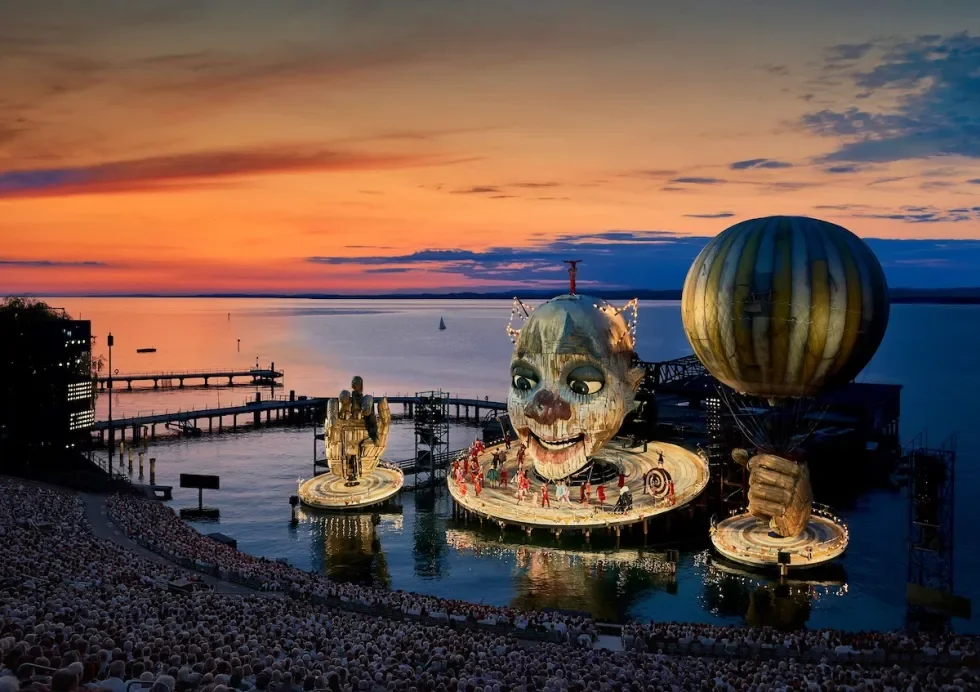
Together, the Bregenz Festival and the Salzburg Festival represent two utterly distinct—and equally essential—expressions of what opera and music theater can be at their most ambitious. The Bregenz Festival is singular in the world for its Seebühne, a vast floating stage set directly on Lake Constance, where opera is staged on an epic, cinematic scale that merges music, engineering, and spectacle. Productions are conceived to interact with water, sky, and landscape, creating performances that are as much immersive environments as they are operatic events. Experiencing opera at Bregenz is to witness how the art form can captivate thousands of people without sacrificing musical integrity—proof that opera can be both grandly populist and artistically serious in a way no indoor theater can replicate.
By contrast, the Salzburg Festival offers the most concentrated immersion in musical excellence anywhere in the world. Founded in Mozart’s birthplace, Salzburg is where opera, orchestral music, and theater converge at the highest possible level, with performances presented by the world’s greatest singers, conductors, orchestras, and directors in acoustically superb historic venues. What makes Salzburg truly special is not only the prestige of its artists, but the depth of its curatorial vision: repertoire is chosen with intellectual rigor and historical awareness, inviting audiences into a living dialogue between tradition and reinvention. For an opera lover, Salzburg is a pilgrimage—a place where one encounters the art form in its most refined, searching, and spiritually resonant form.
Together, Bregenz and Salzburg offer a once-in-a-lifetime opportunity to experience opera at its most spectacular and its most profound.
You will travel with COT General Director Larry Edelson, whose artistic insights will deepen your connection to each production. The tour balances extraordinary performances with the cultural riches, scenic landscapes, and culinary traditions of the region. You will also have time to explore independently and enjoy the rhythm of travel at a comfortable pace. Most importantly, you will share this journey with a community of opera lovers, inquisitive, engaged, and eager to experience the best Austria has to offer.
Operated by Dolce Cultural Tours with principal Dan Cooperman.
ITINERARY
More detailed information about the performances may be found below.
Saturday, August 1 – Departures to Zurich
Independent air departures from the United States to the Zurich Koten Airport (ZRH).
Sunday, August 2 – Arrival in Switzerland and Transfer to Lindau (near Bregenz)
Arrive at Zurich Airport, where private shuttles will bring the group to the Hotel Bayerischer Hof in Lindau (Germany), set on the edge of Lake Constance and close to the Bregenz Festival. Take the afternoon to settle in and adjust after travel.
In the evening, we gather for a welcome dinner, an easy first opportunity to meet one another and look ahead to the week’s performances and shared experiences.
Monday, August 3 – Lindau and The Excursions of Mr. Brouček
Today is designed for rest and easy exploration. Enjoy breakfast at the hotel and take the morning and afternoon to get to know Lindau. Its harbor, lakeside promenades, and quiet streets make for a pleasant day at your own pace.
In the evening, we travel by coach to Bregenz for dinner at a local Wirtshaus, followed by a performance of Leoš Janáček’s The Excursions of Mr. Brouček, directed by Yuval Sharon, the American director known for his innovative work with Detroit Opera and The Industry LA. Janáček’s opera is a sharp, imaginative satire that moves its reluctant hero through bizarre worlds and unlikely trials, balancing humor and musical intensity along the way.
Tuesday, August 4 – Bregenz and La traviata
This morning, we travel by coach to the Bregenz waterfront for a guided tour of the Seebühne, the festival’s extraordinary floating stage and the setting for tonight’s performance. We meet with a member of the festival’s artistic leadership and visit a nearby museum before enjoying lunch together. In the afternoon, we return to Lindau for time to rest at the hotel.
In the evening, we gather for a pre-performance dinner at the hotel before boarding a boat to the festival, a scenic way to arrive for the night’s event. We enjoy a welcome drink prior to Verdi’s La traviata, directed by the Italian Damiano Michieletto, who places this beloved story of love and consequence in the dazzling world of the Roaring Twenties.
Wednesday, August 5 – To Salzburg
We depart Lindau this morning by private coach and make our way toward Salzburg, stopping en route for a winery visit and lunch in the countryside. We arrive in the early afternoon and check in, with time to rest and settle in before the evening.
Tonight, we meet for dinner at one of Salzburg’s noted restaurants as warm welcome to the city and its culinary traditions.
Thursday, August 6 – Salzburg Tour and Cosi fan tutte
This morning, we set out on a walking tour of Salzburg, visiting sites tied to Mozart and the city’s deep musical history. We continue to the Festival Hall for a backstage tour and conversation with a member of the artistic team, offering insight into how the Salzburg Festival comes together each summer.
Lunch and the afternoon are on your own to explore the old town, museums, or simply enjoy the atmosphere at a comfortable pace.
In the evening, we gather for a pre-performance dinner before starting our festival experience with Mozart in the city of his birth: Così fan tutte is directed by Christof Loy and conducted by Joana Mallwitz.
Friday, August 7 – Museum Visit and Ariadne auf Naxos
After breakfast, we depart for a guided visit to one of Salzburg’s leading museums, with time to explore the collection and enjoy the city at a relaxed pace. Lunch and the afternoon are free for independent discovery—whether that means more sightseeing, a quiet café, or a walk along the river.
In the evening, we come together for dinner before attending Richard Strauss’s Ariadne auf Naxos at the Salzburg Festival, conducted by Manfred Honeck and directed by Ersan Mondtag, with Elīna Garanča in the title role. The opera weaves comedy and myth into a story about art, desire, and the complicated line between entertainment and transcendence.
Saturday, August 8 – Free Day and Il viaggio a Reims
Today is entirely free for you to enjoy Salzburg on your own schedule. Wander the old town, visit a museum that piques your interest, or simply take the day to relax and soak in the city’s atmosphere.
In the evening, we gather and make our way to the festival for Gioachino Rossini’s Il viaggio a Reims — a sparkling, rarely staged comedy written to celebrate virtuoso voices and witty ensemble interplay. The production is directed by Barrie Kosky, one of the most inventive and imaginative directors in opera today, with Cecilia Bartoli leading a cast that embraces the work’s irreverent spirit and vocal fireworks.
Sunday, August 9 – Outing and Saint François d’Assise
Our final day in Salzburg begins with a cultural outing together, followed by lunch and free time to relax or enjoy the city at your own pace. In the evening, we gather for a festive dinner to mark the week we’ve shared before heading to our last performance: Olivier Messiaen’s Saint François d’Assise. This monumental opera, rarely staged due to its scale, reflects Messiaen’s profound spiritual life, his lifelong relationship with the Catholic Church, and his fascination with birdsong as a form of musical expression. The new production is directed by Romeo Castellucci and conducted by Maxime Pascal, with Philippe Sly in the demanding title role.
Monday, August 10 ‒ Departures from Salzburg
Independent departures from the Salzburg Airport W. A. Mozart (SZG), with private transfer from the hotel.
Tour itinerary and activities may change.
ACCOMMODATIONS
Hotel Bayerischer Hof Lindau
(https://www.bayerischerhof-lindau.de/hotel-bayerischer-hof-lindau)
The five-star Hotel Bayerischer Hof sits right on the picturesque harbor promenade of Lindau, Germany, just a short distance along the shore of Lake Constance from the Bregenz Festival. With elegantly appointed rooms and suites, a full-service spa, and fine dining in its lakeside restaurant, it delivers refined comfort in a setting of timeless charm. Its location makes it effortless to explore Lindau’s old town, step out to ferry connections, or simply enjoy quiet waterfront walks, offering guests sweeping views of the lake, the Alps, and the town’s historic harbor. .
NH Collection Salzburg City
(https://www.nh-collection.com/en/hotel/nh-collection-salzburg-city)
The four-star NH Collection Salzburg City sits just steps from the Mirabell Gardens, in the heart of Salzburg’s vibrant Andräviertel district, an ideal base for exploring Mozart’s birthplace, historic streets, and the city’s lively coffee and dining scene. Its 140 rooms offer a quiet retreat after a day of sightseeing: warm, modern interiors and summer garden terrace for cocktails. It’s a welcoming, stylish home base to wander Salzburg’s baroque old town by foot and relax between performances.
TOUR INCLUSIONS
● Six opera performances with premium tickets
● Eight nights in 4/5-star hotels
● Daily breakfast, three lunches, and seven dinners
● Private transfers from Zurich Airport and to Salzburg Airport
● Luxury coach transportation between cities
● Performance introductions by COT General Director Larry Edelson
● Tour guides and entrance fees, as required
● Tour guide, driver, and restaurant gratuities
● Chicago Opera Theater General Director Larry Edelson and Dolce Cultural Tour Leader Dan Cooperman as your tour coordinators
Not included:
● Flights and ground transportation to Zurich and from Salzburg
● Meals not included in the itinerary
● Travel insurance (recommended)
● International medical coverage (recommended)
Travelers are strongly recommended to independently purchase a comprehensive travel protection plan including travel insurance and international medical coverage.
TOUR RATES & REGISTRATION
Book early to ensure your place! Capacity on this tour is extremely limited.
The trip rates for double and single occupancy travelers are provided based on current Euro exchange rates. The final tour price may be adjusted at the time of the third payment based on changes to currency exchange rates.
Estimated Double Occupancy: $11,500 per traveler
Estimated Single Occupancy Supplement: $1,800 per traveler ($13,300 total)
Room upgrades may be requested at supplemental cost to travelers; subject to availability.
Travelers who wish to arrive early in Zurich must make their own arrangements for hotel stays prior to the tour start. Those who wish to depart later from Salzburg can request additional hotel nights at supplemental cost to travelers; subject to availability.
Registration & Payment Schedule
Complete the forms below to register according to the following payment schedule.
1. Deposit: A 25% deposit per traveler is required at the time of registration, by January 30, 2026.
2. Installment: A 50% installment is due by February 28, 2026.
3. Balance: The final balance per traveler is due April 1, 2026. The balance may be adjusted based on U.S. Dollar conversion rates on March 31, 2026. (If a traveler opts to pay in full at the time of registration, an adjustment to the final price may be made based on the March 31 exchange rate.)
Trip Green-Light & Cancellation Policy
Travelers will be notified by February 1, 2026, if the tour has reached a sufficient registration capacity to move forward. Travelers are advised not to purchase airfare or other non-refundable services until receiving the green light on the tour. In the case that sufficient capacity is not achieved, the tour will either be cancelled with full refunds or offered at an adjusted rate to travelers.
The deposit is non-refundable unless the tour cannot proceed. From March 1 to May 1, partial refunds may be offered at the discretion of Dolce Cultural Tours based on the ability to acquire refunds from suppliers or transfer traveler’s spot on the tour to a new traveler. After May 1, no refunds will be offered.
Your tour registration will be processed by Dolce Cultural Tours. Read the full Terms & Conditions at www.dolcecultural.com/TC-COT26.
PERFORMANCE DETAILS
BREGENZ FESTIVAL
The Excursions of Mr. Brouček
Leoš Janáček
Opera in two acts (1920, rev. 1926)
Libretto by Leoš Janáček
Sung in Czech with German and English surtitles
CREATIVE TEAM
Conductor: Robert Jindra
Stage Director: Yuval Sharon
Stage Designer, Costume Designer: Jon Bausor
Lighting Designer: Yi Zhao
Video: Hannah Wasileski
CAST
Matěj Brouček: Daniel Brenna
Mazal, Blankytný, Petřík: Mihails Culpajevs
Sakristan, Lunobor, Domšík: Károly Szemerédy
Málinka, Etherea, Kunka: Tatev Baroyan
Würfl, Čaroskvoucí, Schöffe: Allen Michael Jones
Číšníček, Wunderkind, Student: Nikki Treurniet
Kedruta: Jana Kurucová
Svatopluk Čech, I. Táborita: Svatopluk Sem
Composer / Harfoboj / Miroslav Zlatník: Linard Vrielink
Maler, Duhoslav, Professor’s voice, Vojta od Pávů, II. Táborita: Paul Curievici
Poet, other Poet, Oblačný, Vacek Bradatý: Lukáš Bařák
ENSEMBLES
Chorus: Prague Philharmonic Choir
Orchestra: Wiener Symphoniker
Matěj Brouček really just wants one thing: to be left in peace. The world is too loud, too complicated, too exhausting. He would rather retreat into the safety of his own four walls. But life has other plans: Brouček is torn from his comfort zone—first catapulted to the moon, then thrown into 15th-century Prague. Grotesque societies, bizarre trials await him, and a past that feels surprisingly contemporary. But do these journeys change him at all—or does he remain the same person after all? With The Excursions of Mr Brouček, Leoš Janáček created an opera of biting wit and profound comedy—a satire on bourgeois complacency, moral laziness, and humanity’s eternal inability to learn from history. Janáček’s music oscillates with virtuoso ease between irony and pathos, between waltzing bliss and passionate choral passages, between the everyday and utopia. In the staging by US-American director Yuval Sharon, Brouček is not portrayed merely as a drunk petty bourgeois, but as a man unaware of his own narrow-mindedness. This is an opera full of original humor and existential depth.
La traviata
Giuseppe Verdi
Melodramma in three acts (1853)
Libretto by Francesco Maria Piave
Sung in Italian with German and English surtitles
CREATIVE TEAM
Conductor: Kirill Karabits, Pietro Rizzo
Stage Director: Damiano Michieletto
Stage Designer: Paolo Fantin
Costume Designer: Carla Teti
Lighting Designer: Alessandro Carletti
Video: Roland Horvath
Choreography: Thomas Wilhelm
Sound: Alwin Bösch, Clemens Wannemacher
CAST
Violetta Valéry: Stacey Alleaume, Julia Muzychenko, Marjukka Tepponen
Flora Bervoix: Rinat Shaham, Angela Simkin
Annina: Claire Barnett-Jones, Melissa Zgouridi
Alfredo Germont: Julien Behr, Long Long, Jose Simerilla Romero
Giorgio Germont: Audun Iversen, Kostas Smoriginas, Vladimir Stoyanov
Gastone: Andrew Kim, Taylan Reinhard
Barone Douphol: Kevin Greenlaw, Michael C. Havlicek
Marchese d'Obigny: Janne Sihvo, Pete Thanapat
Dottore Grenvil: Ivo Stanchev, Stanislav Vorobyov
Giuseppe: Aaron Godfrey-Mayes, Raphaël Jardin
In a roaring sea of champagne, dance, and elegance, Violetta Valéry indulges in the vibrant life of Parisian society. Yet behind the glittering façade there is a woman whose heart longs for more than glamour and pleasure. When the young Alfredo Germont enters her world, a different life seems within reach—a life built on love and sincerity. But in a society where money and reputation reign supreme, there is little room for true feelings. With La traviata, Giuseppe Verdi created an opera of poignant beauty—with moving arias, compelling choral scenes, and an orchestral sound that makes the longing and drama of this tragic love story palpable in every note. The musical direction will be led by Kirill Karabits and Pietro Rizzo, both making their debut at the Bregenzer Festspiele. Italian director Damiano Michieletto sets the production in the glamorous world of the Roaring Twenties. Against a backdrop of dazzling jazz clubs and decadent evening soirées, Violetta—torn between her lust for life and fragility—must make a decision that will seal her fate forever.
SALZBURG FESTIVAL
Cosi Fan Tutte
Wolfgang Amadeus Mozart
ossia LA SCUOLA DEGLI AMANTI
Dramma giocoso in two acts K. 588 (1790)
Libretto by Lorenzo Da Ponte
Expanded revival
CREATIVE TEAM
Conductor: Joana Mallwitz
Director: Christof Loy
Sets: Johannes Leiacker
Costumes: Barbara Drosihn
Lighting: Olaf Winter
CAST
Fiordiligi: Elsa Dreisig
Dorabella: Victoria Karkacheva
Guglielmo: Andrè Schuen
Ferrando: Bogdan Volkov
Despina: Lea Desandre
Don Alfonso: Johannes Martin Kränzle
ENSEMBLES
Concert Association of the Vienna State Opera Chorus
Jozef Chabroň Chorus Master
Vienna Philharmonic
Composed in 1789—just after the storming of the Bastille and in the final months of Joseph II’s reign—Così fan tutte captures the last brilliant flowering of the ancien régime on the brink of transformation. The story begins in a Neapolitan coffee house, a place where beauty and unease coexist under the shadow of Vesuvius. In this charged atmosphere, Don Alfonso provokes the young officers Ferrando and Guglielmo into wagering on the fidelity of their fiancées, Fiordiligi and Dorabella. His goal is not merely to expose infidelity, but to prove that love—so often believed immutable—is vulnerable to disguise, chance, and the shifting tides of emotion.
What starts as a playful experiment becomes a ruthless test. Identities blur; loyalties shift. Fiordiligi’s seeming steadfastness buckles under unexpected passion, Dorabella adapts with ease that reveals a deeper fragility, and the men find themselves ensnared in the very game they devised. Even Don Alfonso loses his detachment as all certainties give way. Despina offers the women a pragmatic, even cynical worldview in which love is little more than diversion. Yet her skepticism is not the opera’s final truth. Così fan tutte ultimately asks how humanity—and tenderness—can survive disillusionment.
Mozart’s music reveals that truth. Far from mocking his characters, he writes with profound empathy, binding contradiction into harmony. The final “bella calma” is not a return to naïveté but a serenity shaped by suffering, self-knowledge, and forgiveness. Laughter and tears coexist; equilibrium is fragile but genuine. By the end, all four lovers return to themselves changed—fulfilling the quiet question posed by Heinrich von Kleist: must we taste the fruit of knowledge in order to rediscover innocence?
Ariadne auf Naxos
Richard Strauss
Opera in one act with a prologue op. 60
(composed 1911—2, second version premiered in 1916)
Libretto by Hugo von Hofmannsthal
New production
CREATIVE TEAM
Conductor: Manfred Honeck
Director / Sets / Costumes: Ersan Mondtag
Lighting: Henning Streck
Video: Luis August Krawen
Dramaturgy: Till Briegleb
CAST
The Composer: Kate Lindsey
The Prima Donna / Ariadne: Elīna Garanča
The Tenor / Bacchus: Eric Cutler
Zerbinetta: Ziyi Dai
The Major-Domo: Johannes Silberschneider
The Music Master: Christoph Pohl
The Dancing Master: Jonas Hacker
Harlequin: Leon Košavić
Scaramuccio: Michael Porter
Truffaldino: Lukas Enoch Lemcke
Brighella: Theodore Browne
Naiad: Jasmin Delfs
Dryad: Anja Mittermüller
Echo: Marlene Metzger
ENSEMBLE
Vienna Philharmonic
In Ariadne auf Naxos, the richest man in Vienna is never seen—only felt through the arrogance of his staff. To him, art is a trivial after-dinner amusement, no more important than fireworks. He casually overturns the entire musical program for his grand soirée, humiliating the artists and forcing the up-and-coming Composer to compress his new opera seria or merge it with an opera buffa to avoid “boring” the guests.
Strauss and Hofmannsthal originally conceived Ariadne as part of an adaptation of Molière’s Le Bourgeois gentilhomme, and the portrait of this unseen plutocrat echoes Molière’s lampooning of wealthy philistines. But the 1912 premiere—an awkward hybrid of spoken theater and opera—failed, prompting the creators to replace the play with a new Prologue. This revised version, premiered in 1916, retains the satire while sharpening the backstage chaos as artists and entertainers collide at a frantic comedic pace. Strauss shapes the Prologue in a lively, conversational musical style, while the opera proper—combining the myth of Ariadne with the invented buffa tale of Zerbinetta and her lovers—invokes a more classical, celebratory musical language, filled with echoes of earlier centuries.
Director Ersan Mondtag’s Salzburg production relocates the story to a futuristic world: the wealthiest elites now hold their banquets on Mars, leaving artists to serve as mere “musical confectioners.” On this barren planet, the deserted island of Naxos becomes a metaphor for modern ruthlessness and the wastefulness of those who can afford to flee to ever more exclusive worlds. The myth itself deepens this cosmic frame. Ariadne, rescued by Bacchus and destined to become a constellation, is linked to Daedalus—the first human to fly and an emblem of space-age ambition. In this vision, Strauss and Hofmannsthal’s satire of Viennese bourgeois vanity becomes a parable for our own era, where the palaces of the ultra-rich may soon stand not on the Ringstrasse but in the stars—awaiting their next round of theatrical fireworks.
Il Viaggio a Reims
Gioachino Rossini
ossia L’ALBERGO DEL GIGLIO D’ORO
Dramma giocoso in one act (1825)
Libretto by Luigi Balochi, partly based on the novel Corinne, ou L’Italie by Madame de Staël
Revival
CREATIVE TEAM
Conductor: Gianluca Capuano
Director: Barrie Kosky
Sets: Rufus Didwiszus
Costumes: Victoria Behr
Lighting: Franck Evin
Dramaturgy: Christian Arseni
CAST
Corinna: Cecilia Bartoli
Marchesa Melibea: Marina Viotti
Contessa di Folleville: Mélissa Petit
Madama Cortese: Tara Erraught
Cavalier Belfiore: Edgardo Rocha
Conte di Libenskof: Dmitry Korchak
Lord Sidney: Ildebrando D’Arcangelo
Don Profondo: Florian Sempey
Barone di Trombonok: Misha Kiria
Don Alvaro: Peter Kellner
Don Prudenzio: Giovanni Romeo
Maddalena: Helena Rasker
Zefirino: Rodolphe Briand
Antonio: Rafał Pawnuk
ENSEMBLES
Chœur de l’Opéra de Monte-Carlo
Stefano Visconti Chorus Master
Les Musiciens du Prince — Monaco
People-watching in a hotel lobby can be endlessly entertaining—especially when the guests resemble the colorful ensemble of Rossini’s Il viaggio a Reims. A group of international travelers, all eager to reach Reims for the coronation of Charles X, find themselves stranded in a provincial spa hotel for want of horses. Stuck together, they form a lively parade of flirtation, rivalry, vanity, and eccentricity.
Rossini wrote the opera for the coronation festivities, but after its 1825 premiere and three performances, he shelved the score and later recycled much of its music in Le Comte Ory. Believed lost, the remaining manuscript resurfaced in 1977, enabling a full reconstruction and a triumphant modern revival in 1984 at Pesaro. With its eighteen roles—ten of them major virtuosic parts—Il viaggio a Reims was an extravagance worthy of a royal celebration. Both Rossini and his librettist, Luigi Balochi, embraced their commission with playful irreverence. The international hotel setting lets them tease national stereotypes and poke fun at the conventions of Italian opera itself, making the work as much a meta-opera as a buffa. Moments of comic excess—like the fashion-obsessed Contessa di Folleville grieving over a lost trunk as though mourning a tragedy—show Rossini’s music spiraling into delightful, self-propelling frenzy while still revealing genuine human warmth.
Director Barrie Kosky views the opera’s limited plot as a creative gift, using it as a springboard for Feydeau-like physical comedy and gleeful farce. Paired with Rossini’s electrifying ensembles—including a remarkable concertato for fourteen voices—the result promises a whirlwind of humor and musical exuberance. In all the joyful chaos, it’s easy to forget the opera began as a tribute to an ultra-conservative king.
Saint François d’Assise
Olivier Messiaen
Scènes franciscaines
Opera in three acts and eight scenes
(created 1975—83, premiered in 1983)
Libretto by Olivier Messiaen
New production
CREATIVE TEAM
Conductor: Maxime Pascal
Director / Sets / Costumes / Lighting: Romeo Castellucci
Artistic Collaborator: Giulia Giammona
Dramaturgy: Christian Longchamp
Choreography: Yasmine Hugonnet
Associate Set Designers: Alessio Valmori, Lisa Behensky
Associate Costume Designer: Theresa Wilson
Associate Lighting Designer: Benedikt Zehm
Sound Director: Paul Jeukendrup
CAST
L’Ange: Lauranne Oliva
Saint François: Philippe Sly
Le Lépreux: Sean Panikkar
Frère Léon: Russell Braun
Frère Massée: Léo Vermot-Desroches
Frère Élie: Aaron-Casey Gould
Frère Bernard: Willard White
ENSEMBLES
Concert Association of the Vienna State Opera Chorus
Jozef Chabroň Chorus Master
Vienna Philharmonic
In its vast spiritual scope, sensual intensity, and sheer artistic daring, Olivier Messiaen’s Saint François d’Assise holds a place in late 20th-century music comparable to Wagner’s Tristan und Isolde in the 19th. Both are landmark works shaped by an overwhelming love that leads toward death—Wagner’s a human passion, Messiaen’s a divine one, centered on St Francis’s love for Christ.
A devout Catholic and lifelong organist at La Trinité in Paris, Messiaen combined radical musical imagination with deep religious conviction. This dual nature, already evident in works like the monumental Vingt Regards sur l’Enfant-Jésus, is joined by a third passion: birdsong. For decades he travelled the world transcribing birds, and their music finds its fullest expression in Saint François, his only opera—dedicated fittingly to the saint who preached to the birds.
The opera’s massive vocal and orchestral forces make performances rare, but the 800th anniversary of St Francis’s death in 2026 reminds us why this work remains essential. Messiaen portrays Francis not as the gentle figure of tourist iconography, but as a profoundly radical visionary: renouncing his past, embracing extreme poverty, and pursuing a mystical identification with Christ’s suffering. The opera invites us into this demanding spiritual world and offers an existential experience that still speaks powerfully today.
Messiaen spent decades shaping this magnum opus, a summation of his life’s work. Its return to Salzburg reopens Francis’s “path of grace,” inviting us to follow. This new production reunites director Romeo Castellucci and conductor Maxime Pascal at the Felsenreitschule, with Philippe Sly debuting in a role unlike any other—one that offers a deeply human journey grounded in the earth, its stones, and the vastness within us.